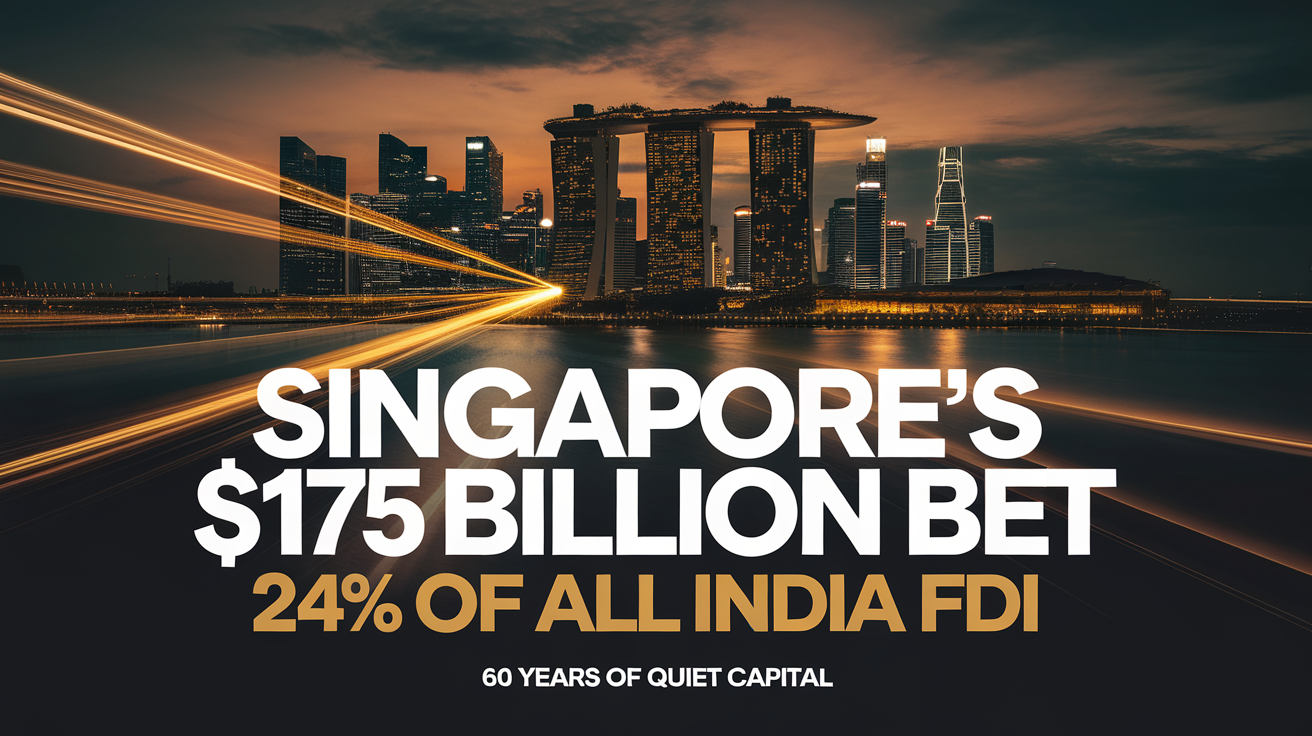
That is how much money Singapore has poured into India between April 2000 and March 2025 — confirmed by India's Department for Promotion of Industry and Internal Trade.
24%.
That is Singapore's share of every dollar of foreign direct investment that has ever entered India.
For context: that is bigger than the United States, the United Kingdom, and Japan combined. And it has happened so quietly that ask any business journalist outside Asia who India's number-one foreign investor is — they will guess wrong.
Singapore has been India's largest source of foreign direct investment for seven straight fiscal years. It is not a tie. It is not close. And the gap to second place is widening, not narrowing.
The cumulative number, $174.886 billion, only counts FDI as defined by India's official statistics — equity, reinvested earnings, and other capital. It does not count the listed-equity portfolio, the private credit, the real estate, or the venture allocations that Singapore-domiciled funds quietly run into Indian companies every quarter.
| Singapore in India — the headline numbers | Value | Source & period |
|---|---|---|
| Cumulative FDI from Singapore | $174.886 billion | DPIIT, Apr 2000 – Mar 2025 |
| Singapore's share of total India FDI | ~24% | HCI Singapore, FY 2024-25 |
| FDI from Singapore in FY 2024-25 alone | ~$15 billion | Deccan Herald, Jun 2025 |
| GIC India listed-equity portfolio | ₹1,77,951.6 cr (~$21 bn) | TickerTape disclosed holdings, Dec 2025 |
| GIC's number of disclosed Indian listed positions | 50 companies | TickerTape, Dec 2025 |
| Singapore's share of India's ASEAN trade | 27.83% | HCI Singapore, FY 2024-25 |
GIC alone — Singapore's sovereign wealth fund — owns large stakes in HDFC Bank, ICICI Bank, Bharti Airtel, Bajaj Finance, and Larsen & Toubro. These are not satellite positions. These are anchor holdings in the companies that account for a meaningful share of the Nifty 50's free float.
Temasek, the other Singapore state investor, has taken bets across India's private credit, healthcare, financial services and digital infrastructure, in addition to its public-market exposure. The two together represent the most consistent foreign institutional money flowing into India over the past decade — quieter than US pension funds, more patient than Gulf sovereign wealth, more concentrated than Japanese trading houses.
Here is the part that does not fit the usual "growing partnership" story.
In FY 2024-25 — the same year Singapore re-confirmed its #1 FDI ranking, the same year both prime ministers signed five new MoUs, the same year the Comprehensive Strategic Partnership Roadmap was adopted — India-Singapore bilateral merchandise trade fell 3.7%.
| Bilateral merchandise trade | Volume | Change |
|---|---|---|
| FY 2023-24 | $35.6 billion | — |
| FY 2024-25 | $34.3 billion | −3.7% |
| FY 2025-26 (Apr-Nov 2025) | $23.61 billion | tracking ~flat |
So: the political relationship deepened. The capital relationship hit records. The goods-trade relationship contracted. That is not contradiction. That is a signal — and it is the signal that explains why both governments are spending so much energy on the next phase.
Goods trade is a 20th-century measurement. The India-Singapore corridor in 2026 is being built around services, equity, real estate, digital assets, and venture capital — categories that were always under-counted in the bilateral trade column. The CECA (Comprehensive Economic Cooperation Agreement) signed in 2005 was supposed to be the framework that updated those rules. Its third review was launched in September 2018. It has still not been formally concluded.
The decoupling, decoded
Capital is being deployed faster than the legal framework around it can be modernized. Trade is shrinking because the framework is stale, not because the relationship is. The CSP (Sept 2024) and Roadmap (Sept 2025) are how both sides are routing around the stalled CECA — by building parallel governance lanes for AI, semiconductors, defence, space, civil aviation, green shipping, and digital assets. Each lane is its own MoU. Each MoU is its own bilateral mechanism. The CECA upgrade may finally close in 2026 — but the action has already moved past it.
If you only read headlines, you missed it. The compression from "60-year-old bilateral relationship" to "operationalized strategic corridor" happened over an 18-month window between September 2024 and Spring 2026. The pace is unusually fast for either country's diplomatic style.
Each event in isolation reads as routine bilateral activity. The compression is what's not routine. In 18 months, India and Singapore signed off on a strategic partnership tier upgrade, an eight-area cooperation roadmap, five sectoral MoUs, an AI-Summit joint declaration, an annual ministerial roundtable, a state-level cooperation framework, and a fresh wave of corporate cross-border vehicles.
$175 Billion. 24%. The Rest Is Footnotes.One way to feel the scale of Singapore's position: stack it against India's other top FDI sources since 2000.
Singapore plus Mauritius alone account for nearly half of all FDI India has received this century — and both routes are anchored in regulated, English-speaking, common-law jurisdictions. The "Singapore route" is so dominant that any analysis of Indian capital flows that ignores it is, functionally, incomplete.
Now layer in GIC's listed-equity exposure. ₹1,77,951.6 crore — roughly $21 billion — across 50 disclosed positions in Indian listed companies as of December 2025. That number is the floor, not the ceiling: it excludes private equity, real estate, infrastructure, and Temasek's separate book. The actual Singapore footprint in Indian listed and private markets is materially larger than what any one disclosure captures.
How the CSP Actually Works.The Comprehensive Strategic Partnership is not a single agreement. It is a framework of eight priority areas, each with its own sub-mechanism, all monitored by an annual India-Singapore Ministerial Roundtable agreed at the September 2025 summit.
- Economic cooperation — CECA review (overdue), trade facilitation, cross-border payments
- Skills development — National Centre of Excellence for Advanced Manufacturing in Chennai (Singapore-built, India-staffed)
- Digitalization — Digital Asset Innovation MoU, fintech corridor, UPI-PayNow link operations
- Sustainability — Green & Digital Shipping Corridor, civil nuclear cooperation, urban water management
- Connectivity — Civil Aviation MoU, port-to-port shipping rules
- Healthcare and medicine — India-Singapore AI Healthcare Collaboration (formalized at Feb 2026 AI Summit)
- Defence and security — Enhanced Defence Cooperation Agreement (2015), SIMBEX, SITMEX, MILAN, submarine rescue MoU
- People-to-people and cultural — student exchange, diaspora engagement, tourism
The novelty is the governance cadence. Eight priority areas had been listed in older joint statements. The annual ministerial roundtable is what's new — a structural commitment that forces both bureaucracies to file progress reports against each lane every twelve months. That is unusual for India, whose bilateral mechanisms tend to drift unless triggered by a summit.
Three Pathways for International Investors.For executives and capital allocators sitting in Singapore, Hong Kong, the Gulf, or further afield, the practical question is: how do I get exposure to this corridor?
Path A — Singapore-domiciled India funds
The default route. The largest FII flows into India already use Singapore-domiciled vehicles for tax, regulatory, and currency reasons. Pros: well-trodden, fast, deep secondary market liquidity. Cons: returns are largely beta — you are buying Indian large-cap exposure, not the new lanes.
Path B — Wait for the CECA upgrade
The CECA's third review has been stuck since September 2018. If it concludes in 2026, expect updated rules around services, digital trade, and movement of professionals. Pros: clarity on cross-border services costs. Cons: timing is uncertain — seven years of stall is not a strong forecasting signal.
Path C — The new lanes (semicon, AI, defence, green shipping)
Bet on the MoUs that were signed in September 2025. Tata's $11-billion Dholera fab, the AI-Healthcare collaboration, and the Green & Digital Shipping Corridor each represent fresh institutional plumbing. Pros: highest upside, earliest mover advantage. Cons: long horizon, project execution risk, fewer secondary exit paths.
The bilateral has set up four concrete forcing events between now and the end of 2026. Watch these:
| Event | Timing | Why it matters |
|---|---|---|
| Tata Dholera fab — first commercial chip | Late 2026 | Tata Group + PSMC (Taiwan): ₹91,000 crore / $11B, 50,000 wafers/month at 28-110nm. India's first modern semiconductor fab to ship product. The Singapore semiconductor cooperation track depends on this milestone landing. |
| CECA third review conclusion | 2026 (overdue) | Stuck since Sept 2018. Conclusion would unlock services trade, digital rules, and possibly the long-disputed movement-of-persons provisions. |
| India-Singapore Ministerial Roundtable | Annual cadence (next: 2026) | The new governance ritual. Progress reports against each of the 8 CSP priority areas. Forces bureaucratic accountability. |
| Anant Raj-style cross-border vehicles | Quarterly | The Apr 2026 Anant Raj Singapore cloud unit was the first. Watch the count of Indian-origin companies setting up Singapore subsidiaries for global expansion. That number is the leading indicator of how the corridor is being used in practice. |
Most stories about the internationalization of India's UPI focus on France (Eiffel Tower demo), the UAE, Bhutan, or Mauritius. The original real-money cross-border UPI corridor — the one that has handled the most consistent retail flow — is between Singapore's PayNow and India's UPI, launched in February 2023.
That corridor was not signed at a Davos plenary. It was negotiated quietly between the Reserve Bank of India and the Monetary Authority of Singapore (MAS), and went live ahead of every other UPI cross-border partnership. The MAS has been India's most consistent and operationally active bilateral central bank counterparty for the entire UPI internationalization program.
It is exactly the kind of thing that makes the headline numbers — $174.886 billion FDI, ₹1.78 lakh crore listed equity — slightly misleading. The capital relationship is layered with infrastructure plumbing the public never sees. The PayNow-UPI link is one example. Submarine rescue cooperation under the defence track is another. The Green and Digital Shipping Corridor is a third. None of these are visible on any GA dashboard, any FDI table, or any trade-volume chart.
Singapore Is Becoming India's Regulated Gateway.Step back. What is the structural story here?
For India: Singapore offers what no other partner currently offers in one place — common-law jurisdiction, top-tier financial market infrastructure, English-speaking dispute resolution, no political baggage, geographic proximity, and a regulatory regime that international institutions trust. For non-Chinese global capital looking to underwrite Indian growth, Singapore is the cleanest channel.
For Singapore: India is the next ten-year domestic-demand growth engine in Asia. Domestic-demographic dividend, infrastructure spend, services exports, IT talent — every one of Singapore's existing financial-hub capabilities can be exported into Indian deal flow at margin. CSP institutionalizes that flow.
For everyone else: The Singapore-India corridor is functionally the most institutionalized bilateral lane in Asia outside China. For any allocator that has a "non-China Asia" mandate — and the share of those mandates is growing — this corridor is where the capital naturally lands. The CSP just made the political wrapper match the financial reality.
The China dimension: Singapore's neutrality and India's strategic positioning combine into one of the most resilient corridors in the region. It is not framed as a China hedge in any official document. It is structured like one in practice.
Bottom line
Singapore is not a footnote in India's foreign-capital story. Singapore is the story — 24% of every FDI dollar India has ever received, $174.886 billion cumulative, sole #1 source for seven straight fiscal years.
The 2024-25 Comprehensive Strategic Partnership did not create the relationship. It put a public framework around the institutional plumbing that was already there. The CECA upgrade may finally close in 2026; the AI, defence, semiconductor, green shipping, and digital-asset lanes are already operating outside it.
For executives reading this from Singapore, Hong Kong, the Gulf, or any global allocator with non-China Asia exposure: the most institutionalized bilateral capital lane in Asia just doubled its political wrapper. The financial corridor was already the answer. The CSP, the CECA upgrade, and the new MoU lanes only change how you get in — not whether you should.
Reporting cross-checked against Department for Promotion of Industry and Internal Trade (DPIIT), Singapore's Ministry of Foreign Affairs, India's Prime Minister's Office, Singapore's Ministry of Trade and Industry, the High Commission of India in Singapore, the Republic of Singapore Navy, the Press Information Bureau (Government of India), Tata Electronics, Tata Group, IBEF, Outlook Business, The Statesman, Business Standard, Deccan Herald, Wikipedia, ORF, NUS-ISAS, Carbon Credits, Datacenter Dynamics, BusinessToday and TickerTape — 24+ sources cross-verified.