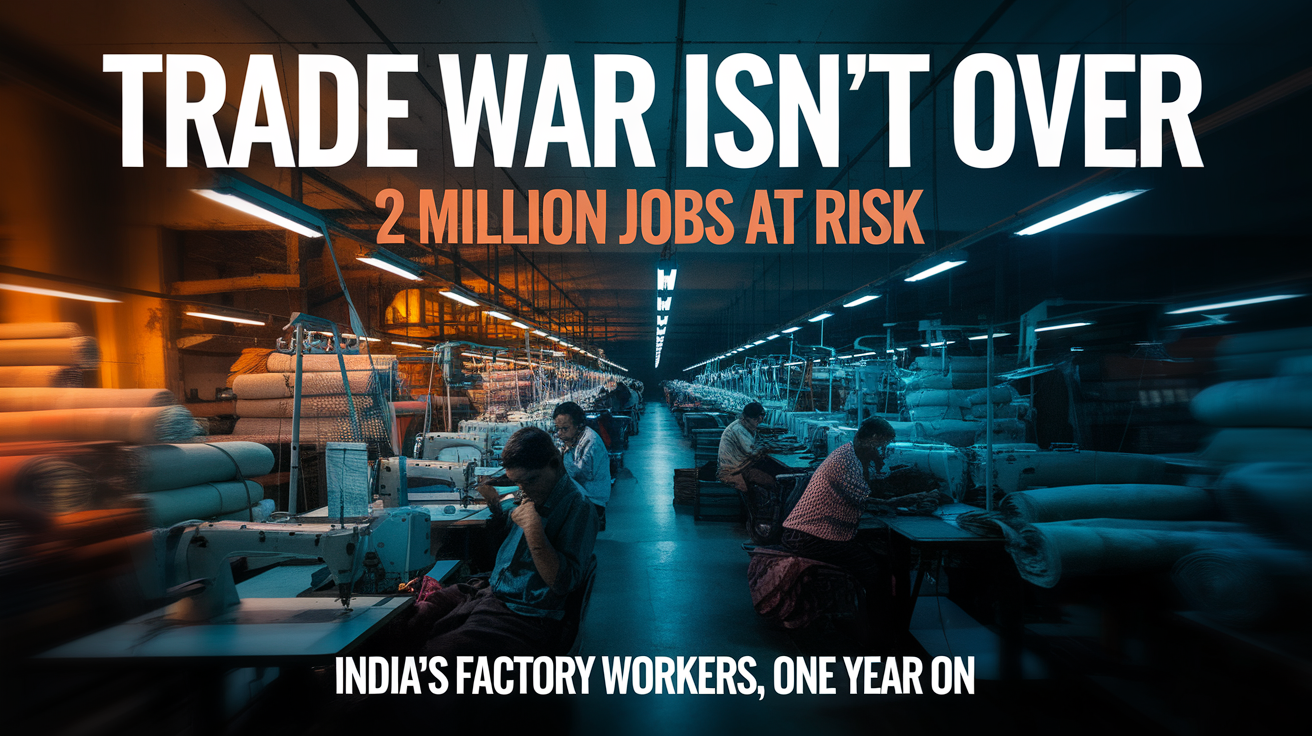
India woke up to 50% tariffs on everything it sells to America.
Today, the tariff is down to 10%. On paper, India “won.” In Tiruppur, the garment capital of South India, 150,000 workers are still at risk. In Ludhiana, half a million hosiery workers still face a shrunken order book. And India’s manufacturing activity just hit its lowest level in four years.
The official story says the crisis is over. The factory floor says something different.
45 Million Workers. $36 Billion. One American Decision.To understand why this hit so hard, you need to know what India’s export economy actually looks like. The textiles and garment industry alone employs 45 million people — making it India’s second-largest employer after agriculture. The US is India’s single largest export destination, buying roughly $86.5 billion worth of Indian goods every year.
For garments specifically, one in every four rupees earned comes from American buyers. Tiruppur in Tamil Nadu alone accounts for 60% of India’s garment export earnings. The city of Ludhiana ships $700 million worth of hosiery and knitwear to the US every year, employing over 500,000 workers in that trade alone.
These are not abstract numbers. They are families, factories, and supply chains that had built their entire business model around one assumption: that selling to America would always be roughly the same deal.
In April 2025, that assumption was shattered overnight.
50%. 18%. 10%. How India Got Here.Trump’s “Liberation Day” tariffs, announced on April 2, 2025, hit India with a 25% “reciprocal” tariff — the White House’s way of penalizing countries it said taxed American goods unfairly. For India, this was painful but survivable.
Then came the second blow. In August 2025, the US added a further 25% penalty specifically for India’s purchases of Russian oil. The combined rate: 50%. For context, that made India’s tariff rate among the highest of any major US trading partner.
The damage was immediate. US buyers started cancelling orders, shifting purchases to Bangladesh and Vietnam. Factories in Tiruppur began reducing shifts. By September 2025, estimates put 2 million textile and apparel jobs at risk. Reports from garment hubs described workers being furloughed with no clear timeline for return.
On February 2, 2026, Prime Minister Modi flew to Washington. A deal was announced: India agreed to stop buying Russian oil, pledged to purchase $500 billion worth of US goods over five years, and opened its doors to zero tariffs on US industrial goods. In exchange, the tariff dropped from 50% to 18%.
Then on February 20, 2026, the US Supreme Court struck down the Liberation Day tariffs entirely — ruling 6-3 that Trump had used emergency economic powers illegally. India’s tariff dropped again, to 10%. Lower, in fact, than the WTO-standard rates that existed before the trade war began.
What India Gave. What India Got.The deal looks like a win for India. The tariff is down to 10%. But the fine print is steep.
| India Agreed To | India Received |
|---|---|
| Stop buying Russian oil | Tariff cut from 50% to 18% |
| Buy $500B in US goods over 5 years | SCOTUS ruling brought rate to 10% |
| Zero tariffs on US industrial goods | Pharma exports kept exempt |
| Open to US agricultural imports (limited) | Ongoing FTA negotiations |
The Russian oil commitment is the most consequential concession. India had been buying deeply discounted Russian crude since 2022, saving an estimated $13 per barrel on roughly 1.9 million barrels per day. That discount is now gone. With Middle East tensions keeping global oil prices elevated, India is paying significantly more for energy — costs that flow directly into factory input prices.
The $500 billion purchase pledge is even more striking in context: India’s entire annual government budget is approximately $590 billion. The commitment amounts to almost everything the government spends in a year — spread across five years in purchases from the US. Analysts at CNBC noted the number appears ambitious at best.
Textiles Got Crushed. Pharma Got a Free Pass.Not every sector suffered equally. The US government specifically exempted several industries from its tariff regime — a decision that reveals exactly which imports America cannot afford to lose.
Pharmaceuticals were fully exempt from day one. The Nifty Pharma index jumped 3.2% the day the exemption was confirmed — because the US relies on Indian generics for roughly 40% of its prescription drug supply. Semiconductors and critical minerals were also kept off the tariff list.
For textiles, gems, jewellery, shrimp, and carpets, there was no such protection. These sectors absorbed the full weight of a 50% duty for the better part of 2025. Even now, at 10%, the damage done to order pipelines, buyer relationships, and factory capacity doesn’t simply reverse when a number changes on a spreadsheet.
The Tariff Came Down. The Pain Didn’t.Here is what the official tariff numbers don’t show. India’s manufacturing sector in March 2026 recorded its worst performance in four years. The HSBC India Manufacturing Purchasing Managers’ Index fell to 53.9, down from 56.9 in February — the lowest reading since June 2022.
More alarming: input cost inflation hit a 43-month high — the worst since August 2022. The costs hitting factories include aluminium, chemicals, fuel, rubber, steel, fabric, and oil. All elevated. All feeding into the price of every item India makes and tries to sell.
Why are costs still this high even after tariff relief? Three compounding reasons:
First, India is now buying oil at global market prices instead of the discounted Russian rate it surrendered. Energy costs have flowed through to every factory that runs machinery, heats dye vats, or transports goods.
Second, the Middle East conflict — still ongoing — has kept shipping costs and raw material prices elevated globally.
Third, buyer relationships take time to rebuild. Factories that were dropped by US importers in mid-2025 don’t automatically get their orders back when the tariff rate changes. Some buyers shifted to Bangladesh and Vietnam and signed new contracts. Rebuilding that pipeline takes months, sometimes years.
The Deal Was Worth It
- Tariff at 10% is lower than pre-Trump WTO rates — a structural win
- Pharma, semiconductors, and critical minerals all protected
- US-India FTA negotiations now formally open — long-term potential
- India diversifying exports — EU and UK FTAs also in progress
India Paid Too High a Price
- Lost the $13/barrel Russian oil discount — permanent energy cost increase
- $500B US purchase pledge equals India’s entire annual govt budget
- Factory damage from 2025 is not reversing quickly
- New Section 301 probe still active — another tariff round possible
The trade war is not over. It has entered a quieter, more complicated phase. Here are the three things that will determine whether India’s factories actually recover.
1. The Section 301 probe. Even as the Liberation Day tariffs fell, the US Trade Representative quietly launched a new Section 301 investigation targeting India and other countries. Public comments are due by April 15, 2026. This probe could result in a fresh round of targeted tariffs on specific Indian goods — possibly technology, digital services, or agricultural products. The fight is not over.
2. The EU and UK deals. India is simultaneously negotiating free trade agreements with both the European Union and the United Kingdom. If either deal closes in 2026, it would significantly reduce India’s dependence on the US as an export destination — and give Indian manufacturers a cushion if the Washington relationship turns hostile again. The EU deal in particular would be transformative: the EU is India’s largest trading bloc.
3. The China+1 opportunity. There is a silver lining that most factory workers in Tiruppur aren’t hearing about yet. Global brands — squeezed by tariffs on China — are actively diversifying their supply chains. McKinsey, WEF, and BCG all document the same shift: companies are moving from cost-led sourcing to risk-led diversification. India is on every shortlist as a China alternative for textiles, electronics assembly, and chemicals. The factories that survive this period will be positioned to absorb a wave of relocated manufacturing orders — if India can solve its infrastructure and logistics gaps.
The Bottom Line
India negotiated its tariff rate from 50% down to 10% in a year — a diplomatic win on paper. But the cost was real: a permanent energy price increase from abandoning Russian oil, an ambitious $500 billion US purchase pledge, and a factory sector still reeling from 2025’s order collapse. The tariff number changed. The underlying damage to workers, supply chains, and buyer relationships is recovering slowly. The next test is already scheduled: a new US trade probe with an April 15 deadline. The trade war didn’t end — it just changed form.